Great Gatsby Essay

What is corruption? According to Dictionary.com, “ 1. dishonest or fraudulent conduct by those in power, typically involving bribery.” Corruption begins when those in power are involved in fraud and/or bribery. For example, the idea of corruption is shown through the American dream, which is portrayed by the life of one’s happiness and luxury as well as the things people would do to achieve it. Even after obtaining the American dream, corruption causes one to lose more than earn. In F.Scott Fitzgerald, ‘The Great Gatsby’, corruption in the American dream is shown through affairs in relationships such as marriage and/or family, the power of wealth and social status.

Fitzgerald symbolizes corruption through affairs in relationships for instance, marriage and/or family, more specifically, the affairs in Tom and Daisy’s marriage. “‘She never loved you, do you hear?’ he cried. ‘She only married you because I was poor and she was tired of waiting for me. It was a terrible mistake, but in her heart she never loved any one except me!’” (Fitzgerald 139). Gatsby explains to Tom how Daisy loves him. This causes a disagreement between Gatsby and Tom. Gatsby loves Daisy so much that he confronts Tom over who Daisy really loves. Gatsby’s love for Daisy corrupts him into trying to pursue Daisy in having an affair, even though she is married. Although, everyone in the Great Gatsby believes that the American Dream is based on luxury, money and having power, to Gatsby it’s Daisy and doing everything and anything to get to be with her. “‘Tom’s got some woman in New York.’…‘She might have the decency not to telephone him at dinner-time. Don’t you think?’ The telephone rang inside, startlingly, and as Daisy shook her head decisively at Tom the subject of the stables, in fact all subjects, vanished into air.”(Fitzgerald 18-19). Miss. Baker is talking to Nick over Tom’s affair with a ‘some women’ in New York. Tom is having an affair with Myrtle. Although Tom believes that Daisy doesn’t know about Myrtle, she does. An affair in society is seen as dishonest but in The Great Gatsby it’s seen as a form of corruption.

Moreover, the journey to the American Dream is corrupted by the power of wealth. “[H]e gave her a string of pearls . . . I was a bridesmaid. . . . She…pulled out the . . . pearls . . . “Take ’em down-stairs and give ’em back to whoever they belong to. Tell ’em all Daisy’s change’ her mine. Say: ‘Daisy’s change’ her mind!’”(Fitzgerald 82). If one has money, it brings them the power to be closer to the American Dream. The pearls symbolize the corruption of the American Dream due to society’s ideals, over how money is power. Daisy wouldn’t return the pearls nor say that she changed her mind in order to uphold her current lifestyle, revealing Daisy’s true unhappiness with her marriage.“When I asked him what business he was in he answered: “That’s my affair,” before he realized that it wasn’t an appropriate reply. “Oh, I’ve been in several things,” he corrected himself.”I was in the drug business and then I was in the oil business. But I’m not in either one now.” He looked at me with more attention. “Do you mean you’ve been thinking over what I proposed the other night?”” (Fitzgerald 90). When Gatsby explains his journey to wealth, Nick realizes that Gatsby’s approach in business was dishonest.  Although, Gatsby was an underprivileged man who did shady deals to become wealthy. Society saw only his wealth, not how he got his money, just that now he is wealthy and now he is a step closer to the American Dream.

Furthermore, Fitzgerald explains how one’s social status allows them to be “closer” to the “ideals” of the American Dream. “‘I married him because I thought he was a gentleman,’ she said finally. ‘I thought he knew something about breeding, but he wasn’t fit to lick my shoe.’” (Fitzgerald 38). Myrtle begins to talk about George- her husband- over how he tricked her into marrying him by making her believe he was rich when he was actually poor. Myrtle was a lower class-man who has an affair with Tom due to social status, as a rich ‘ideal’ man. This shows how selfish and materialistic Myrtle was because she mostly cared about money and the things that come along with Tom such as his wealth and social status. This reveals the true negative impact the American Dream has on Myrtle, due to not caring about the affair she is having so she can live her materialistic life with a big social status. “You see I think everything’s terrible anyhow, she went on . . . “”Did you see and trouble on the road?” he asked after a minute. “yes.” he hesitated. “was she killed?” “yes.” “I thought so; I told Daisy I thought so. It’s better that the shock should all come at once. she stood it pretty well.” He spoke as if Daisy’s reaction was the only thing that mattered” (Fitzgerald 153). Nick is speaking to Gatsby over Myrtle’s death, due to the found evidence Gatsby is seen as a suspect because Gatsby’s car was what caused Myrtle’s death. Although Nick believes Gatsby was the one to kill Myrtle it was actually Daisy. Myrtle’s affair with her husband as well as the promising ideals of the American Dream affected Daisy to corrupt herself and kill Myrtle out of jealousy and to continue her lifestyle as an important woman.
Internship- Day 5

I began my morning by coming into my internship (City of Austin- Watershed Department) early. To get a head start on practicing for my presentation. Afterwards, our co-workers looked over our presentation and suggested some edits then we went into a conference room to practice presenting the presentation. Finally we went upstairs to the conference room on the 12th floor. Savanah presented her presentation first about what she learned and the project she worked on then finally Emme and I presented last about our rain garden designs.

Internship- Day 4

Today we discussed the final items left to develop and design a rain garden. For example, the cost in development and design as well as the operations and maintenance. We went through a presentation on how to get the cost. Once we did that we set up the cost into three parts the high, average, and low cost to help determine all the factors needed just incase. Afterwards Emme and I finalized our rain garden designs and began working on our presentation. The overview of our presentation is a pitch over our rain garden designs for the ends of the trail, to determine whether building the Rutland rain garden is better then building the Northgate or if building both is a better investment. Finally, Emme and I finished our presentation and asked our co-works to give comments and edits as me pre-present. After receiving some feedback overall we only needed to add our units and making sure that the presentations information is the same.

Internship- Day 3

We began the morning with a presentation over types of plants you should plant in a rain garden and why this is a big important part in developing the rain garden. For example, if you place plants that grow too big in the entrance and exit, that tends to block the flow of the water. Afterwards, Emme and I had some independent work time. We both decided to research over what kind of plants would be best to plant for each rain garden, depending on their soil and location. Furthermore, we had a presentation where we learned about design elements. For example, in a spreadsheet we calculated all of our infiltration information and other factors that helped us determine how much space of land we will be need for each rain garden to be built and be successful. Finally, we had some more independent work time where Emme hand drew our landscape for the exit of the trail- where one of our rain gardens will be built-. Then we put all our information into abobe illustrator, so we could have a formal sketch of the rain garden with its requirements on the curb cut and the rain garden itself.

Internship- Day 2

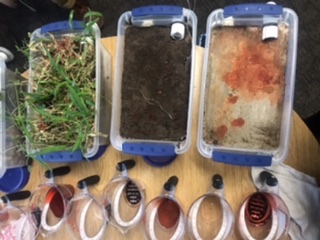
The morning began by doing some independent research on rain gardens and how stormwater controls measure works. For example, the rain gardens sizing, the types of vegetables to plan in rain gardens, as well as being aware of pedestrians when developing a rain garden, and different way to soil test. Furthermore, we continued the morning by going over the property that we will design a rain garden. We mostly talked about the soil type/ study and the infiltration percentage rate and how that could effect the rain garden. After lunch we observed different model types to see how much runoff each there is from each turfs and how much cleaner water comes.

Models used to test runoff and infiltration rate. (Far right is the concert, then the one on the middle is soil without any plants)
Continuation of the models used to test the runoff and infiltration rate. (Far left is a rain garden, then the next on is one with just grass and weeds)

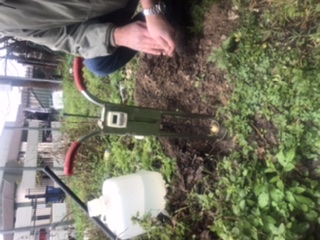
After watching the different model types and seeing how as each model had a different infiltration rate and runoff we continued by having a presentation on infiltration so we can take what we learned and apply it to the field test. Finally, we went to visit the site to test the infiltration on each end of the trail, to see which end will be the most effect for a rain garden.

Testing the infiltration rate of the soil at the beginning of the trail

Internship- Day 1

We started the day by having a brief overview of what our week would look like. Then Emme and I learned about enclaves and channels and how to identify them on a map. This helped us figure out the flow of water in a landscape before we decided on a building anything- in this case a water garden-. Another thing we did was taking what we leaned from identify the enclaves and channels on maps and how to put them in the computer. After lunch we visited 3 different sites of examples of water gardens and water gardens in development.

Assertion

Italo Calvino’s, “Why Read the Classics?” Is about how often people nowadays only read in their comfort zone and don’t open their reading experience to other classic books. He starts by saying how all of us feel some sense of shame for the gaps in our reading in other words that people are ashamed to admit that they have not read a famous book. But he reassures the reader that although of his knowledge on the classics there are still many fundamental books that he has not read himself. He structured his essay in 14 points. “In other words, to read a great book for the first time in one’s maturity is an extraordinary pleasure, different from (though one cannot say greater or lesser than) the pleasure of having read it in one’s youth.” He explains how reading in one’s youth could be unpleasant since in order to fully appreciate the classics maturity plays a role in how you interpret a book and whether you understand it or not. Calvino explains how a classic is formative, in the sense that they give a form to future experiences, terms of comparison, schemes for classification, scales of value if the book is read in a person’s youth more often than not all these points are almost always forgotten. Which is why he encourages the reader that there should be a time in adult life to dedicate to revisit the most important books in our youth.

Citizen Essay

“I’ve seen it happen over and over again: a black person gets killed just for being black, and all hell breaks loose. I’ve Tweeted RIP hashtags, reblogged pictures on Tumblr, and signed every petition out there. I always said that if I saw it happen to somebody, I would have the loudest voice, making sure the world knew what went down. Now I am that person, and I’m too afraid to speak” Angie Thomas wrote in The Hate U Give. Angie Thomas’ novel deals with racism, police brutality, and activism the main character -a young woman- goes through in life similar to Claudia Rankine Citizen: An American Lyric. Rankine symbolizes microaggression that African American people experience on a day to day base in society which situates them as different, through her poems and images. In Claudia Rankine, Citizen: An American Lyric her usage of anecdotes formed the poetic lyric to be more relatable, emotionally appealing to the people, and capable to understand the heinous acts witnessed.

The connection the reader makes through Rankine’s anecdotes helpes the reader relate and understand the racial profiling and discrimination African Americans experience. “And when the woman with the multiple degrees says, I didn’t know black women could get cancer, instinctively you take two steps back though all urgency leaves the possibility of any kind of relationship as you realize nowhere is where you will get from here.”(Citizen 45). Racial comments are made upon many people of color due to them being seen as less than a person. Knowing that’s if they say anything would only be worse for them since the color of their skin is seen as a threat so they sit there in silence listening.“At the end of a brief phone conversation, you tell the manager you are speaking with that you will come by his office to sign the form. When you arrive and announce yourself, he blurts out, I didn’t know you were black! I didn’t mean to say that, he then says. Aloud, you say. What? he asks. You didn’t mean to say that aloud. Your transaction goes swiftly after that,¨(Citizen 44). This quote demonstrates an example of racial profiling that a person of color goes through. The manager had a prejudice of what “sounding black” means and “you” don’t fit inside that prejudice. This anecdote makes the reader feel the offense that “you” feel. First, the manager made “you” angry at his inappropriate comment and then they made you feel less “black.” In a way, he is undermined “you’re” identity by telling “you” that you don’t sound black therefore that makes “you” less black. This allows the reader to understand and experience through Rankine’s writing the prejudice and stereotypes which negatively affects people of color.

Furthermore, as Rankine’s gradually continues to tell multiple stories in the form of poems which emotionally connects to the reader. “because white men can’t police their imagination black men are dying” (Citizen 135). Because white men see people’s blackness as a weapon many people of color have died and still continue to die. “Maybe the content of her statement is irrelevant and she only means to signal the stereotype of ‘black people time’ by employing what she perceives to be ‘black people language.’ Maybe she is jealous of whoever kept you and wants to suggest you are nothing or everything to her. Maybe she wants to have a belated conversation about Don Imus and the women’s basketball team he insulted with this language. You don’t know. You don’t know what she means. You don’t know what response she expects from you nor do you care” (Citizen 41-42). This story allows the reader to sympathize with people of color who receive these types of comments all the time. Imagine being a normal human being going about your day, but to everyone else you are just your skin color or, you are just the stereotypes associated with your skin color. And because you look a certain way you must act a certain way, know certain things, be a certain way as if you are not allowed to be your own unique. You must fit into the narrative that society has created for you and other people who look like you.

Moreover, the usage of anecdotes informs the reader the understanding of the heinous acts African Americans witnessed due to their color of skin. “You assumed you two were the only black people in her life. Eventually, she stopped doing this, though she never acknowledged her slippage. And you never called her on it (why not?) and yet, you don’t forget. If this were a domestic tragedy, and it might well be, this would be your fatal flaw—your memory, vessel of your feelings. Do you feel hurt because it’s the “all black people look the same” moment, or because you are being confused with another after being so close to this other?”(Citizen 7). “The route is often associative. You smell good. You are twelve attending Sts. Philip and James School on White Plains Road and the girl sitting in the seat behind asks you to lean to the right during exams so she can copy what you have written. Sister Evelyn is in the habit of taping the 100s and the failing grades to the coat closet doors. The girl is Catholic with waist-length brown hair. You can’t remember her name: Mary? Catherine? You never really speak except for the time she makes her request and later when she tells you you smell good and have features more like a white person. You assume she thinks she is thanking you for letting her cheat and feels better cheating from an almost white person” (Citizen 5).

Reflection-

This essay shows that I’ve learned more about writing textual arguments. Before I’ve gotten use to writing analytical essays and writing and argument essay was hard for me at the beginning but I feel like it okay. I not sure but if I had to pick something out of my essay that made my proud it would probably be my thesis. Something that I felt that I still need to learn about writing an argument is how to set it up to seem like an argument not just an analytical essay.

Citizen Assertion

Claudia Rankine’s “Citizen An American Lyric”, symbolizes microaggression that African American people experience on a day to day base in society which situates them as different. For example, “A woman you do not know wants to join you for lunch. You are visiting her campus. In the café you both order the Caesar salad. This overlap is not the beginning of anything because she immediately points out that she, her father, her grandfather, and you, all attended the same college. She wanted her son to go there as well, but because of affirmative action or minority something—she is not sure what they are calling it these days and weren’t they supposed to get rid of it?— her son wasn’t accepted. You are not sure if you are meant to apologize for this failure of your alma mater’s legacy program; instead you ask where he ended up. The prestigious school she mentions doesn’t seem to assuage her irritation. This exchange, in effect, ends your lunch. The salads arrive.” (Citizen 13) Furthermore, Rankine’s usages of ‘you’ allows the reader to view “Citizen” in a different lens more specifically as a African American citizens that has experiences microaggression and/or racism in society. This shows that society view people of color as different.

Reflection:

I had a hard time writing this assertion. Personality, the part of my assertion I liked at all was the first sentence – the into paragraph-. I tend to get weak after that an become repetitive. I referred to my previous assertion, the rubric, and the ‘Whats is an Assertion’ half sheet.

My Paragraph

I enjoy spending time with my sisters. Sometimes Yamilet- my youngest sister- and I like to play pretend, with her toys. I also have an older sister; she’s in her freshmen year of college, she seems to enjoy college very well. When I was younger I wanted to be just like my older sister, until recently I decided to do my own thing. Sometimes I might think my sisters are annoying, but I still love spending time with them. I have trouble writing and coming up with ideas sometimes my older sister gets frustrated helping me, after all that she still helps me.